




Buying Guides
Best T-Shirt Heat Presses by Budget (2026 Buying Guide)

Aug
Finding the best T-shirt heat press gets much easier once you start from a realistic budget and an honest production number. A home seller pressing a dozen shirts a week does not need what a DTF shop running hundreds of transfers per shift needs. Spending more buys a larger platen, safer loading, repeatable pressure, interchangeable platens, a second workstation or air-powered operation, but each of those only pays for itself when it solves a problem your orders actually have.
This guide compares heat presses across five price tiers, from starter machines under $750 to industrial systems above $5,000, and covers clamshell, slide-out, swing-away, dual-station and pneumatic designs so you can see where each one earns its keep.
How this guide was researched, and what we sell: Buffalo Imaging supplies professional print shops, sublimation studios and apparel decorators, and we are an authorized MicroTec dealer. We also sell Geo Knight. We do not sell Hotronix, HPN or HTVRONT, and those products appear here unlinked because leaving them out would make this comparison less useful to you, not more. This is a comparison of current published manufacturer specifications, warranty terms and advertised prices. It is not a controlled long-term laboratory test of every machine. Competitor prices were checked August 21, 2026 and change often. Prices for the machines we sell are on their product pages rather than in this article, so what you see is always current rather than whatever was true the day this was written. Freight, liftgate service, air compressors, stands, optional platens, dedicated circuits and tax may all be additional.
Best T-Shirt Heat Presses by Budget: Quick Tier List
| Budget | Best Fit | Machines Worth Comparing |
|---|---|---|
| Under $750 | Beginners, home businesses, low-volume sellers | HTVRONT Auto Heat Press 2, HPN CraftPro 15×15, MicroTec Vector 15×15 |
| $750 to $1,250 | Growing shops moving up to a professional 16×20 or 16×24 platen | Hotronix MAXX 250, MicroTec Vector 16×20, MicroTec Vector Pro 16×20, MicroTec Vector 16×24, HPN Signature PRO |
| $1,250 to $2,500 | Daily production, rigid substrates, or throughput bottlenecks | Geo Knight DK20S, MicroTec Titan 16×20 Hybrid, MicroTec Vector 16×20 Swing-Away, MicroTec Vector 16×20 Double Station, Hotronix Auto Clam |
| $2,500 to $5,000 | Advanced single-station control or air-powered repeatability | Hotronix Fusion IQ, MicroTec Titan Pneumatic Slide-Out, MicroTec Titan and Vector dual-station pneumatic models, Geo Knight DK20SP |
| $5,000 and up | Industrial 16×20 throughput or genuinely oversized work | Geo Knight 394-TS, Hotronix Dual Air Fusion IQ, MicroTec Atlas Ultra |
How We Compared These Heat Presses
Maximum temperature is the least useful spec on the sheet. Nearly every reputable press reaches the temperatures DTF, HTV, sublimation and screen-print transfers require. What actually separates these machines in daily use is this:
- Platen size: 15×15 covers most chest placements and standard shirts. 16×20 gives real margin on adult full fronts, full backs and oversized DTF gang sheets.
- Loading method: Clamshells save space, slide-out platens pull the work away from the heat, and swing-away presses clear the loading area entirely while pressing straight down.
- Release system: Auto-open drops the over-pressing risk when your operator is doing three things at once.
- Pressure: A manual knob works. A pressure readout works better across shifts. Pneumatic removes operator-to-operator variance entirely.
- Workstations: A second station only pays when loading time is genuinely leaving the first platen idle.
- Utilities and footprint: Dedicated 20-amp circuits, 220V or three-phase service, external compressors, freight access and floor loading are real constraints, not footnotes.
- Warranty and parts: The longer a press sits in your production path, the more the coverage terms and the speed of technical support matter.
What Do You Actually Gain at Each Budget?
| Budget | What the Extra Money Buys | Do Not Pay More Unless You Need |
|---|---|---|
| Under $750 | A workable 15×15 platen, digital time and temperature control, and either manual pressure or consumer-grade automation | Daily commercial duty, interchangeable platens, or a real parts and service path |
| $750 to $1,250 | A professional 16×20 platen, heavier frame, auto-open release, slide-out loading or swing-away access | Larger artwork in your normal mix, or a loading workflow that saves measurable operator time |
| $1,250 to $2,500 | Heavy welded frames, pressure feedback, deep presets, thick-substrate clearance, or two loading stations without compressed air | Rigid hard goods, tighter repeatability, or enough order volume to keep two stations busy |
| $2,500 to $5,000 | Advanced touchscreen control or air-powered pressure with less operator effort and better consistency between shifts | Air infrastructure you are willing to own, premium control features, or volume that recovers the installed cost |
| $5,000 and up | Industrial force, dual pneumatic stations, three-phase power, or genuinely large-format platens | Documented high volume, embossing, specialty pressure, or oversized work a 16×20 simply cannot produce |
Tier 1: Best T-Shirt Heat Presses Under $750
The Cheapest Way In: HTVRONT Auto Heat Press 2
At roughly $298 when checked, the HTVRONT Auto Heat Press 2 is the lowest-cost automatic machine in this comparison, and it is genuinely clever for the money. Its 15×15 platen, powered closing and opening, seven pressure levels rated from 20 to 80 kg, slide-out drawer, presets and app control remove most of the physical effort a beginner would otherwise face. If you press occasionally, sell at craft fairs, or want to test whether apparel is a business before committing capital, it does that job.
What it is not is a production machine, and the honest reason is not the price. It is a consumer product with a consumer duty cycle, a consumer service path and a consumer pressure system. When a craft press fails in month eight of a busy season, you are managing a replacement rather than a repair, and there is no interchangeable platen ecosystem to grow into. If pressing shirts is how you make money rather than how you spend a weekend, the machines below are built for that and this one is not.
Commercial-Grade Options Under $750
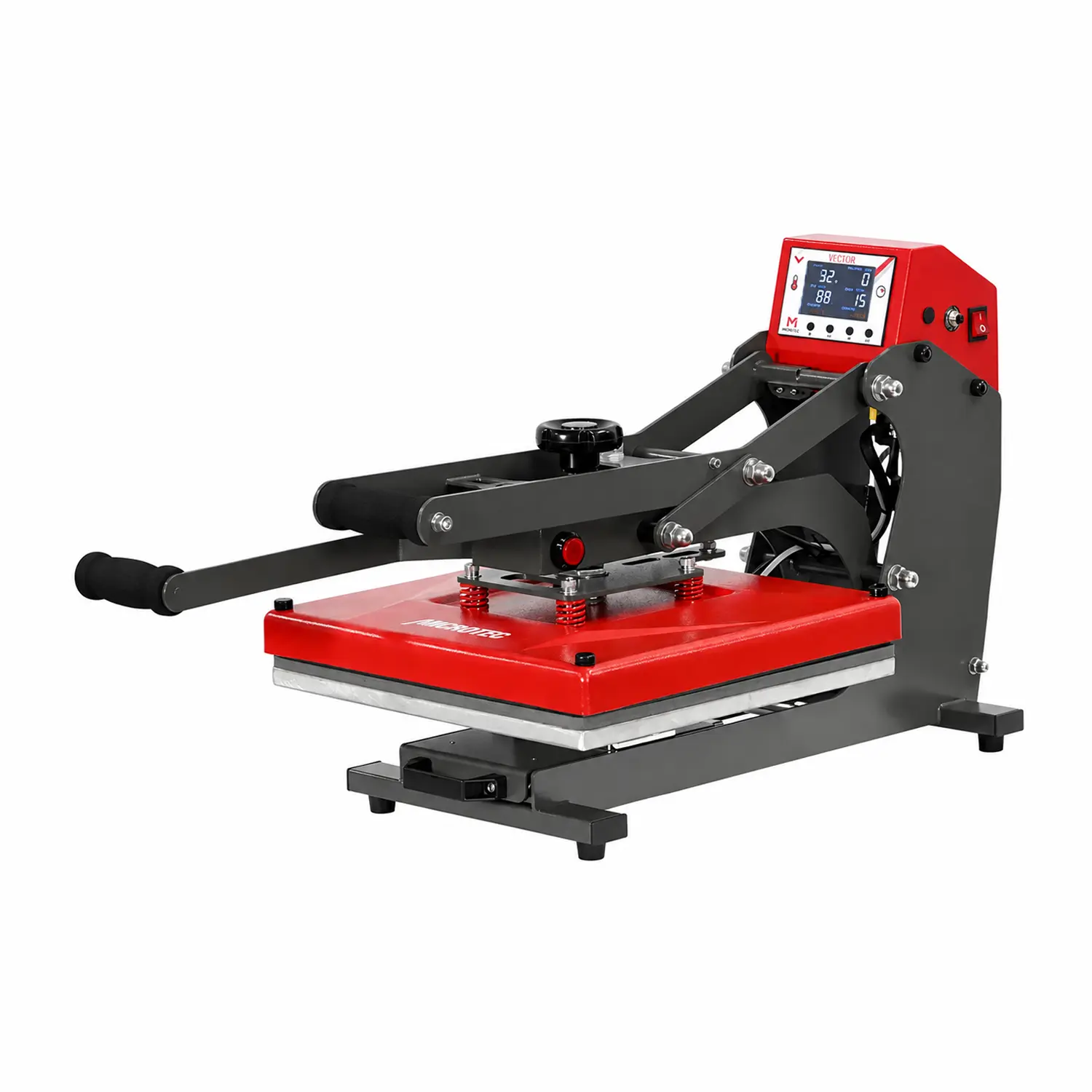
- MicroTec Vector 15×15 Auto-Open Slide-Out: A 14.9 x 14.9 in platen, electromagnetic auto-open that releases the instant the timer hits zero, and a slide-out lower platen that pulls the garment away from the heated element for loading. It runs on standard 120V. The part most buyers miss at this price point is the coverage: a 3-year heating plate warranty plus lifetime technical support from MicroTec USA, against the 1-year coverage that is standard on entry-level clamshells. It costs meaningfully more than the HTVRONT and still uses manual pressure adjustment, so what you are buying is commercial construction, a real service path and auto-open in a conventional press workflow.
- HPN CraftPro 15×15 Clamshell: Listed at $449.95 but marked sold out when checked, this 59.5 lb, 120V manual clamshell offers a 14.91 x 14.91 in platen, slide-out drawer and digital controls. If it returns to stock it is a fair option for someone who specifically wants a traditional spring-loaded press with a pressure knob. It does not auto-open, does not accept interchangeable platens, and requires the operator to close and release every single cycle.
Tier verdict: Buy the HTVRONT if this is a side project and you want to spend the least possible to find out whether it becomes more than that. Buy the MicroTec Vector 15×15 if you are already taking orders, because auto-open, slide-out loading, a 3-year plate warranty and lifetime tech support are what keep a small shop running when one machine is the whole operation. The CraftPro is a reasonable third option when it is actually in stock.

Tier 2: Best 16×20 Heat Presses from $750 to $1,250
This is the tier where most growing shops should be looking, because it is where the 16×20 platen becomes affordable and where a 16×24 first comes within reach. The most common wall operators hit with a 15×15 is full-front placement on adult XL and 2XL garments. Standard full-front designs run 12 to 14 inches wide, which a 15×15 technically covers but with almost no margin for a misaligned transfer. A 16×20 gives you that margin back.
Strongest Manual Value: Hotronix MAXX 250
At its advertised $899 promotional price for 2026, the Hotronix MAXX 250 16×20 is the best conventional manual value in this tier and we do not sell it. It pairs a full 16×20 platen with USA manufacturing, centered pressure adjustment, optional interchangeable lower platens, an 1,800W heating system and lifetime heating-element coverage. If you want a simple commercial clamshell backed by a long heater warranty and a well-established parts platform, and you do not care about automatic opening, that combination is hard to beat at that price.
The limitations are just as clear. The MAXX opens manually and has no slide-out drawer, so the operator loads beneath a raised heater and releases every cycle by hand. And the $899 figure is a promotion rather than a standing list price, so confirm it before you plan a budget around it.
When the MicroTec Vector Pro 16×20 Is the Better Buy
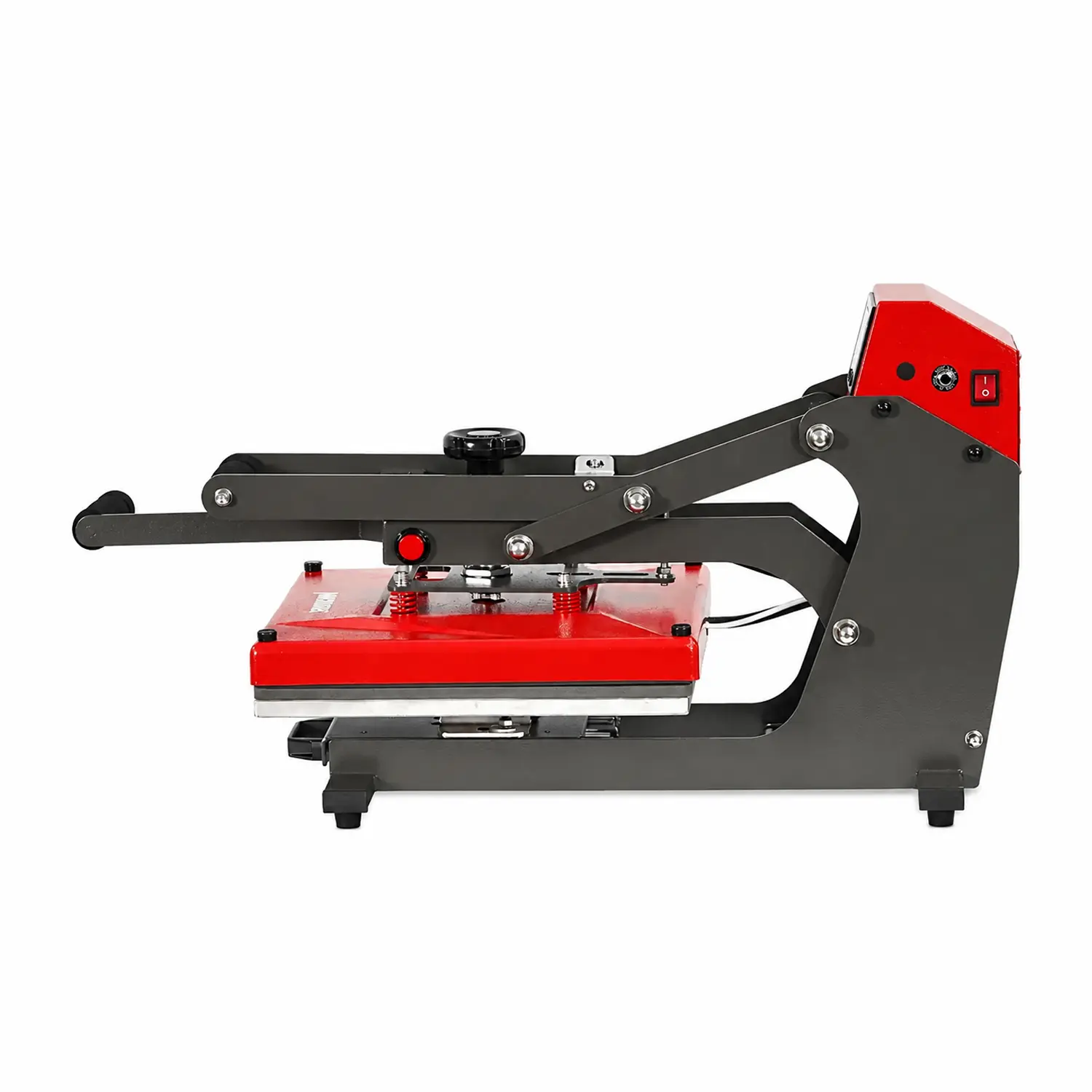
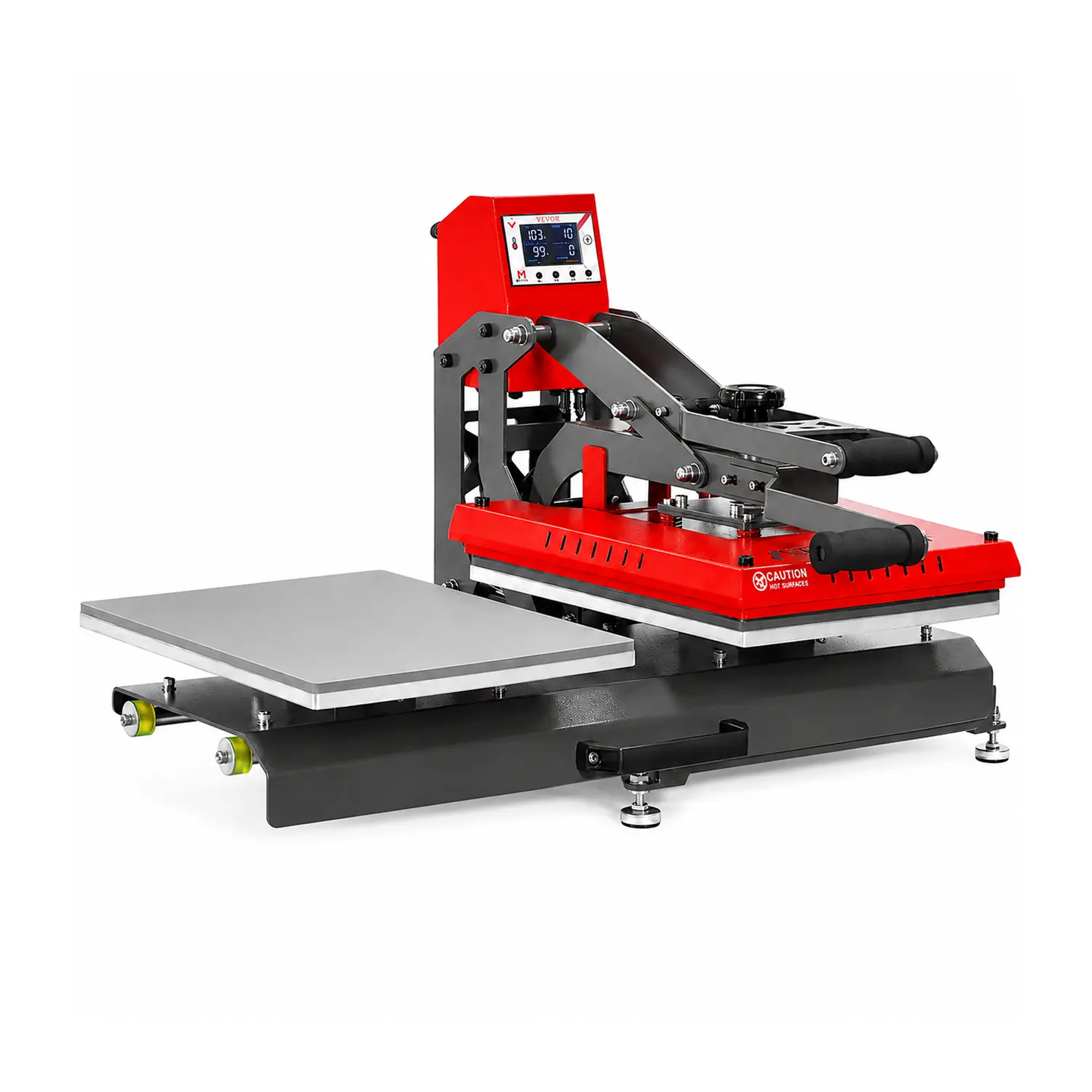
The MicroTec Vector Pro 16×20 Auto-Open Clamshell removes the two things the MAXX asks you to live with. Its 15.7 x 19.7 in platen sits behind an auto-open release and a slide-out lower platen, so you never reach under a hot element and you never reopen the press by hand. It draws 1,700W at 14.2 amps on 120V, which means a dedicated 20-amp circuit is the correct installation, and it needs no compressor. It is rated up to 120 transfers per hour and carries a 3-year heating plate warranty plus lifetime technical support.
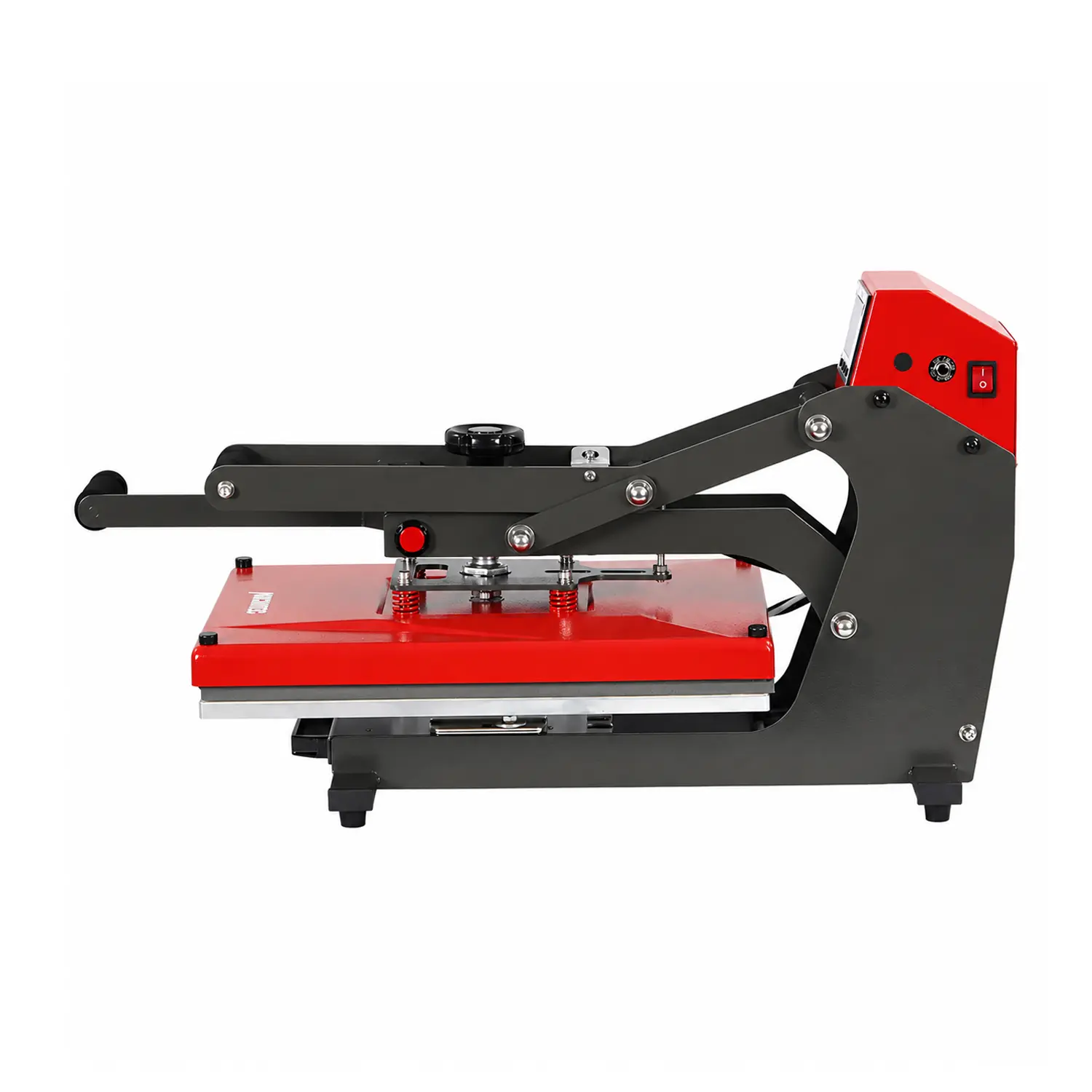


The feature that separates it from everything else in this tier is the quick-change lower platen system, which accepts up to 12 optional platen sizes. That turns one press into a workstation for sleeves, pant legs, bags, labels and youth garments without buying a second machine. If your product line is likely to widen in the next two years, that matters more than the price gap. If it is not, the MAXX 250 is the more economical answer.
The Rest of the MicroTec Ladder in This Tier
The Vector Pro is not the only option here, and two of the alternatives solve problems the Pro does not.
- MicroTec Vector 16×20 Auto-Open Clamshell: The entry point into a full 16×20 platen. Semi-automatic operation, meaning the operator pulls the handle down and the electromagnetic release opens it at the end of the cycle, plus the same slide-out lower platen and 3-year heating plate warranty as the rest of the Vector line. It draws 14.2 amps and wants a dedicated 20-amp circuit. It does not take quick-change platens. If your work is straightforward front and back garment printing and you have no plans to press sleeves or labels, this is the sensible buy and the Pro is money spent on flexibility you will not use.
- MicroTec Vector 16×24 Auto-Open Clamshell: A 15.7 x 23.6 in platen that presses full adult back designs in one pass with no repositioning, no visible seam and no cropped artwork. This is the answer for oversized DTF gang sheets and large-format sublimation transfers that a 16×20 cannot take in a single cycle. Same 1,700W at 14.2 amps, same dedicated 20-amp circuit, rated up to 120 transfers per hour, three presets, a built-in production counter and the 3-year heating plate warranty. Only the platen size and footprint differ from the 16×20.
- MicroTec Vector Pro 16×24 Auto-Open Clamshell: The most capable press in the Vector Pro line, combining the 16×24 back-printing platen with the quick-change lower platen system that accepts up to 12 optional sizes. It sits at the top of this tier or just above it depending on current pricing. Buy it when you need both full back capacity and the ability to run sleeves, pant legs, bags, labels and youth garments on the same machine.
One caution that applies to all three plus the Vector Pro 16×20: at 14.2 amps these exceed the 12-amp continuous load a standard 15-amp circuit safely supports. A dedicated 20-amp circuit is the correct installation, not an upgrade. Sort that out before the press arrives.
When Vertical Pressure Wins: HPN Signature PRO
At roughly $1,150, the HPN Signature PRO 16×20 Swing-Away with SurePressure is an approximately 116 lb solid-steel manual swing-away that applies pressure vertically and uses numbered reference points for repeatability. Its fully open loading area and tolerance for thicker rigid items make it the right shape for plaques, metal panels and hard goods. It uses more floor space, does not auto-open, is not threadable and does not accept interchangeable platens.
Tier verdict: The Hotronix MAXX 250 wins on price for a traditional USA-made 16×20 and we will say so even though we do not sell it. The MicroTec Vector Pro wins when auto-open, slide-out loading and 12 optional platen sizes will save more labor over two years than the price difference costs today. The HPN Signature PRO wins when vertical pressure and open swing-away access matter more than footprint or automation.
Tier 3: Best Commercial Heat Presses from $1,250 to $2,500
This is the widest tier, because three different problems get solved here: rigid substrates, repeatability, and throughput. The right machine depends entirely on which of those three is costing you money.
The Heavy-Duty Benchmark: Geo Knight DK20S
The Geo Knight DK20S 16×20 Digital Swinger is the machine the rest of this tier gets measured against, and it earns that on construction. It is a 200 lb solid welded-steel frame with a thick heating platen, All-Thread table loading, a digital pressure bar graph, 70 programmable presets, instantly interchangeable and rotatable tables, a 32 to 600F range and clearance for materials up to two inches thick. Geo Knight covers the entire press for one year, the heat control for three years and the heating element for the lifetime of the press under original ownership.
Where it is the wrong answer is ordinary shirts. Its mass, its 600F ceiling and its two-inch clearance add nothing to a DTF or HTV workflow, and you still open and close it by hand every cycle. Buy it for rigid substrates, high manual pressure and specialty versatility. Do not buy it because it is the heaviest thing in the room.
Same Swing-Away Geometry, Less Effort: MicroTec Vector 16×20 Swing-Away
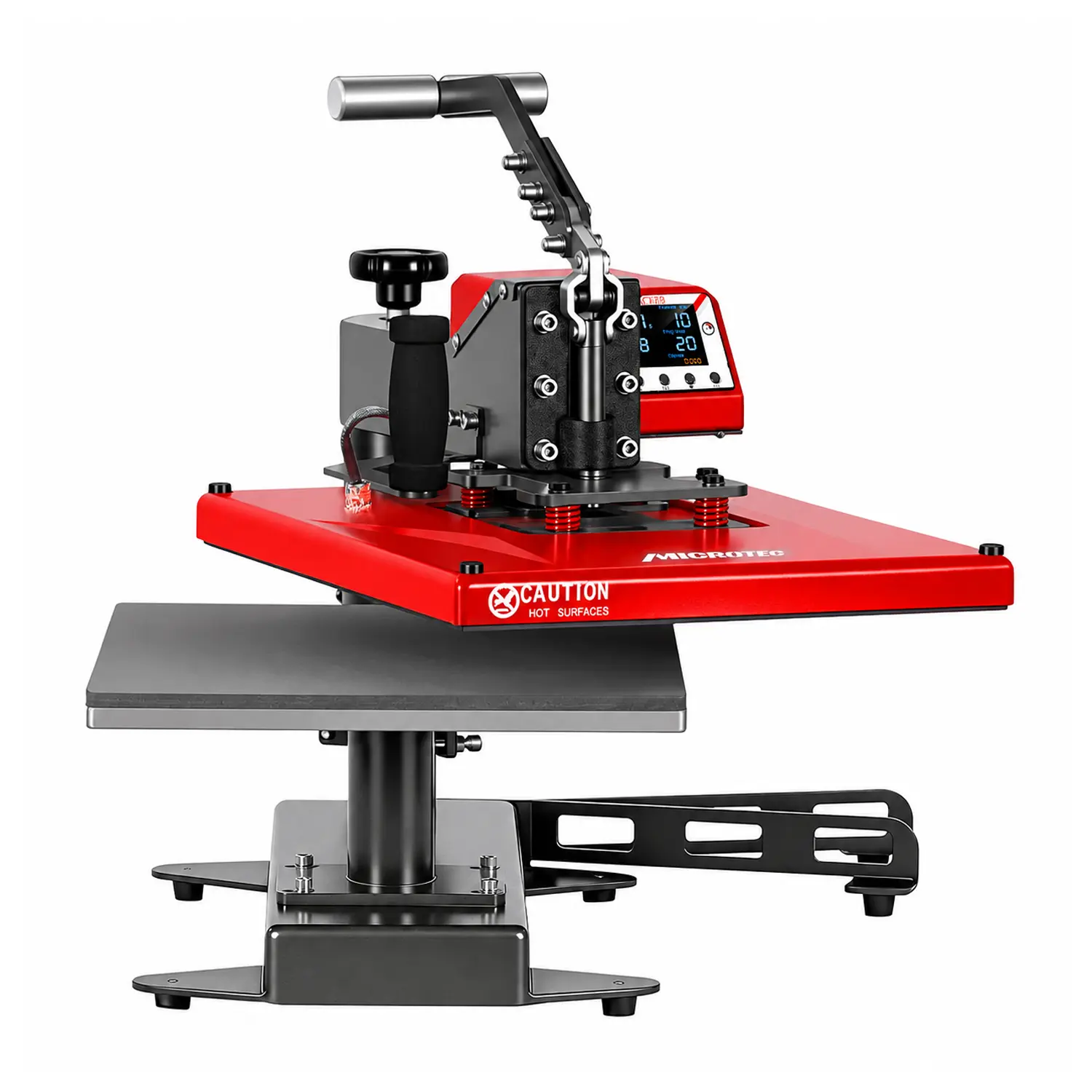
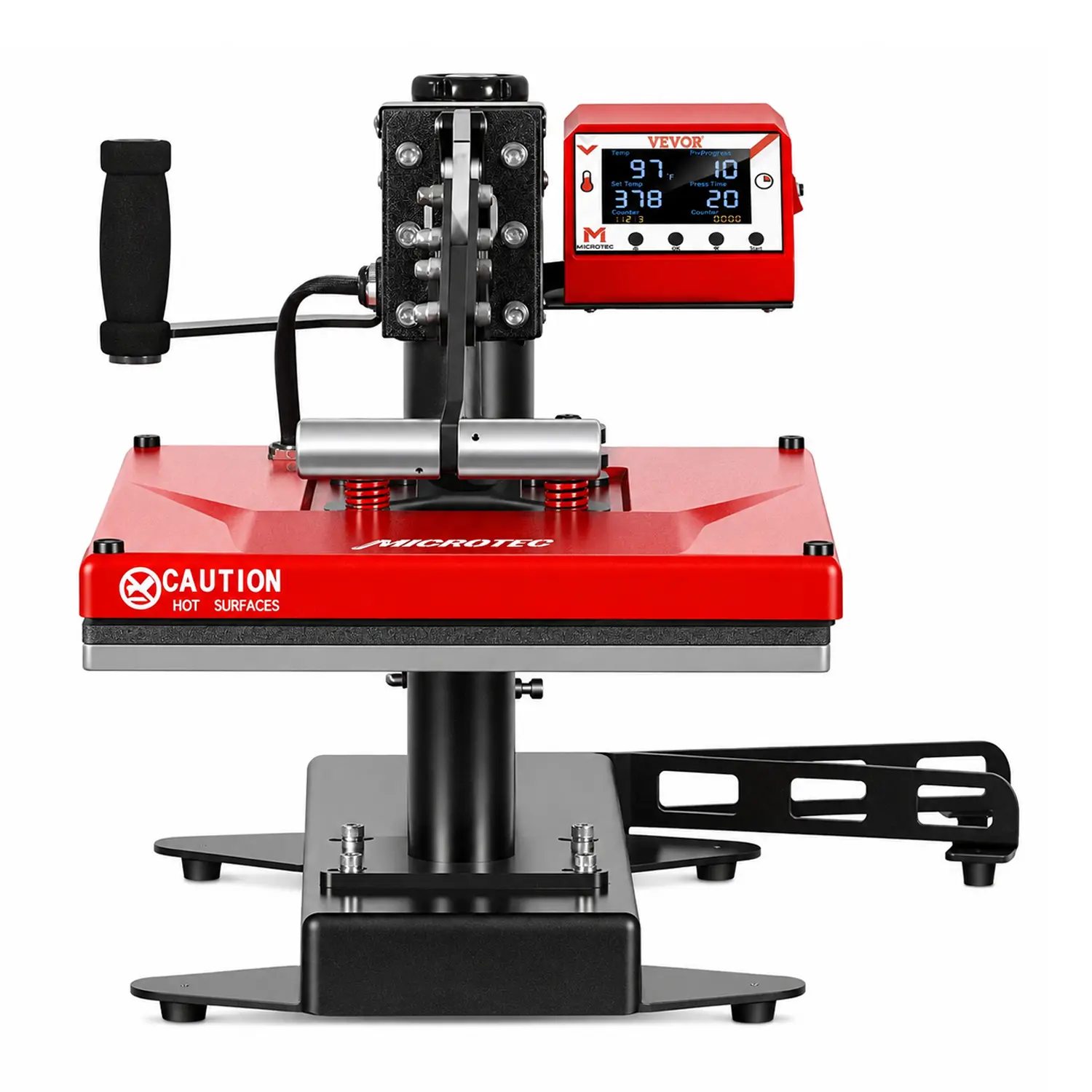
The MicroTec Vector 16×20 Swing-Away gives you the geometry that makes the DK20S useful at a lighter weight and a lower cost. The upper platen swings more than 100 degrees fully clear of the loading area, presses straight down through a 4-point spring-mounted heating element, and adds a secondary leverage handle so the operator is not fighting the press to reach pressure. The 15.7 x 19.7 in platen handles full back prints and oversized DTF gang sheets in one pass, and the temperature range runs 0 to 437F. Coverage is a 3-year heating plate warranty plus lifetime technical support.
It handles the same category of work the DK20S is bought for, including wood panels, ceramic tiles, crystal, ornaments, plaques and license plates, plus screen print curing and DTG finishing. What it does not match is the DK20S frame mass, the 70 presets, the interchangeable table system or the 600F ceiling. If your hard-goods work is regular but not extreme, this is the more sensible machine. If it is extreme, buy the Geo Knight.
Best Single-Station Garment Workflow: MicroTec Titan 16×20 Hybrid
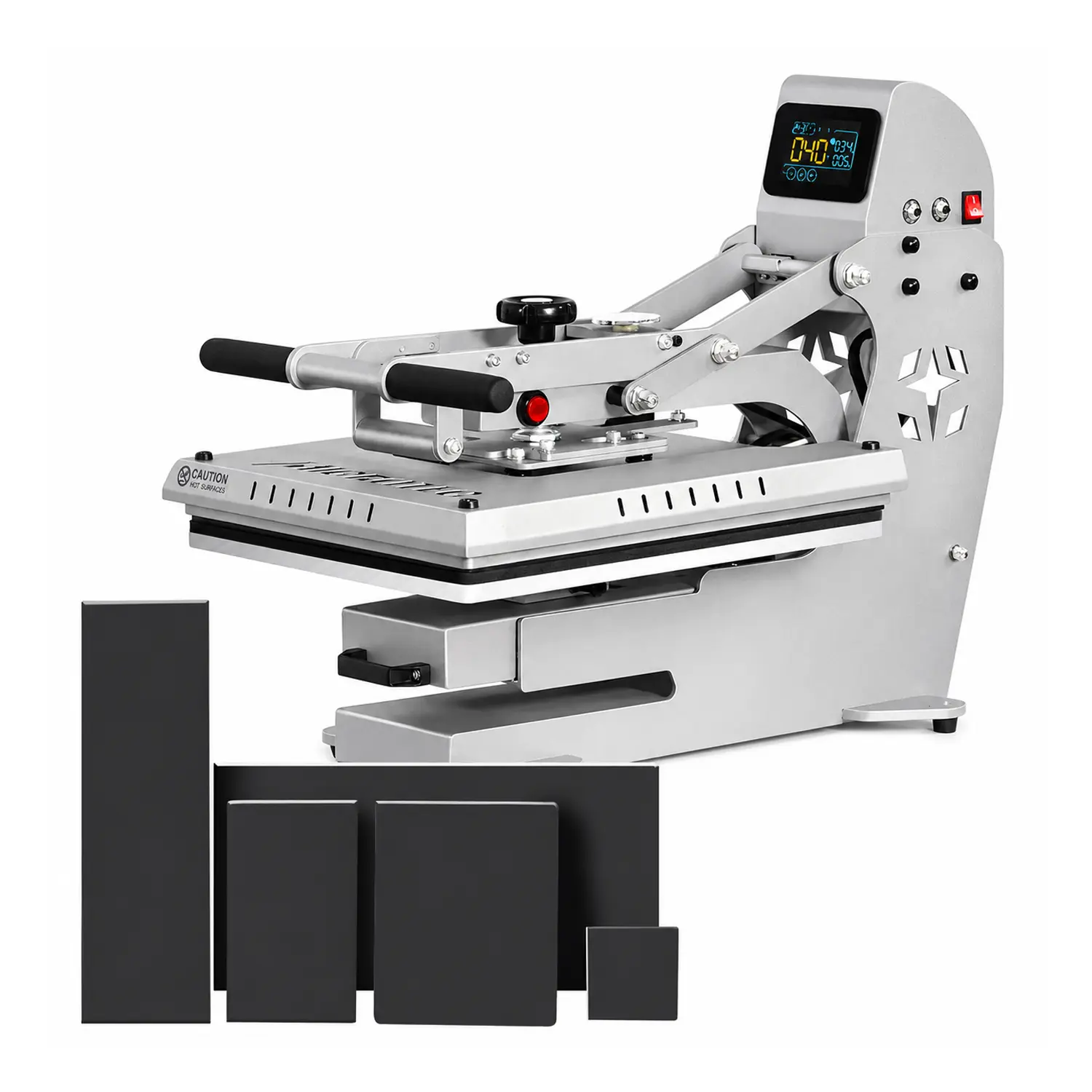
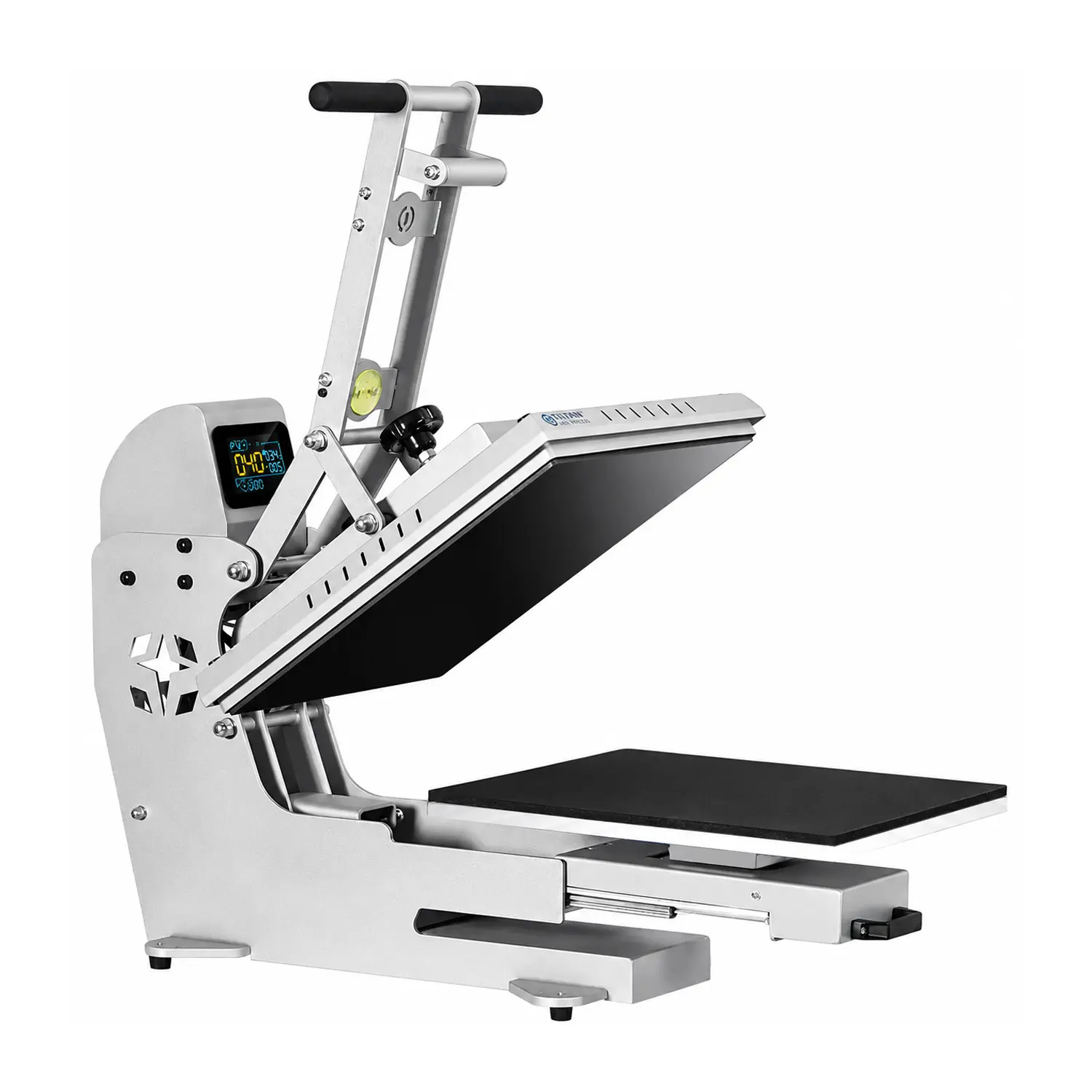
The MicroTec Titan 16×20 Auto-Open Hybrid is the upgraded single-station platform in the Titan line, and it is the most sensible pick in this tier for a shop whose work is mostly garments. It runs auto-open or manual, uses a slide-out lower platen so nobody loads under the heat during a long session, accepts up to 12 optional interchangeable platens, and is rated up to 120 units per hour. It requires no compressor. It carries a lifetime warranty on the heating plate plus lifetime technical support, which is the strongest coverage in this tier from any of these machines.
It is not a swing-away and it will not take a two-inch substrate. For sleeves, labels, youth garments, DTF and HTV run daily by one operator, that is not a limitation you will feel.
When Loading Time Is the Bottleneck: MicroTec Vector 16×20 Double Station
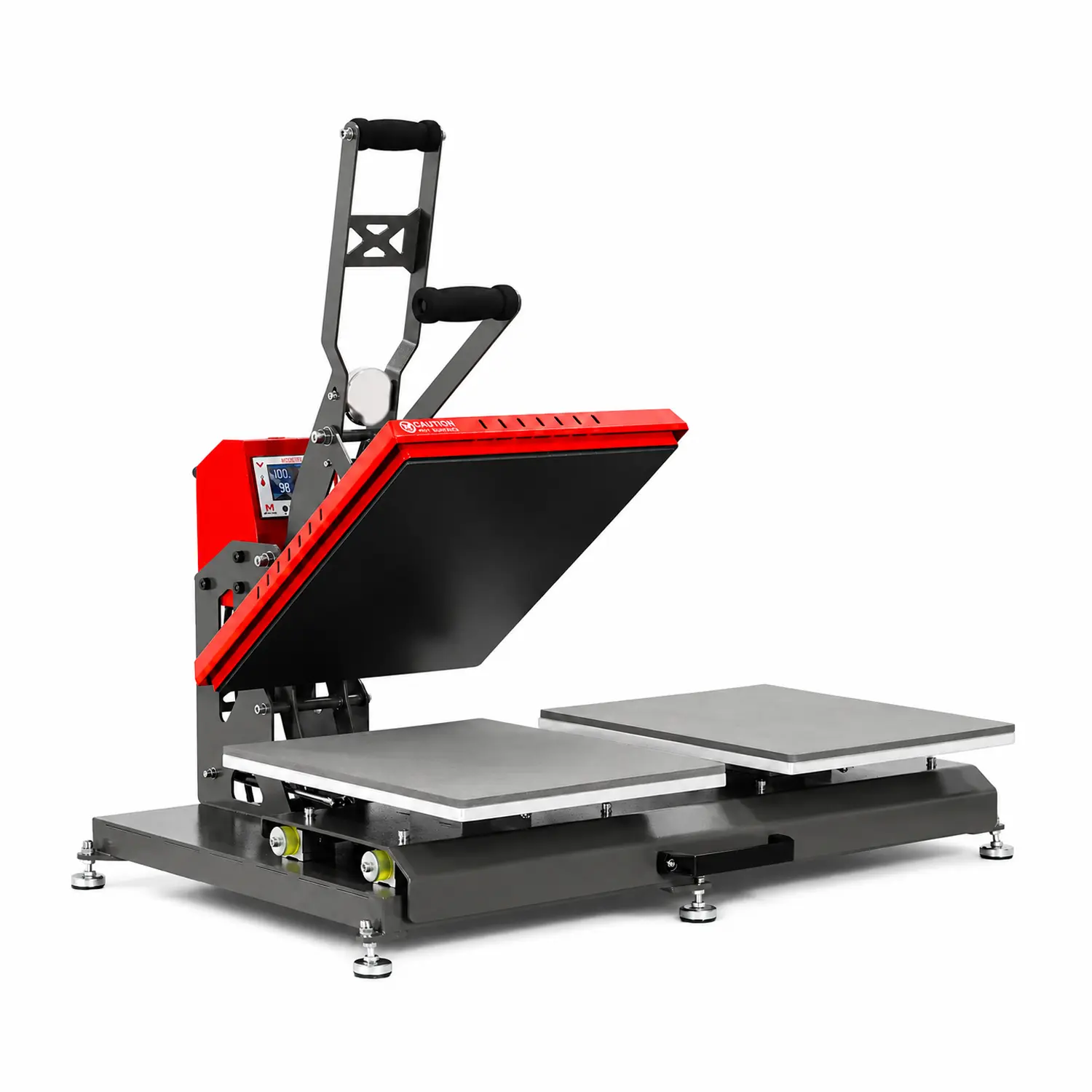
The MicroTec Vector 16×20 Double Station Auto-Open solves a different problem than everything above it. Two independent lower platens slide side to side along a base rail, so while one sits under the heating element the other is pulled out in a heat-free workspace where the operator dresses and aligns the next garment. A gas-shock assisted lid opens automatically at the end of every cycle. It is rated up to 150 units per hour and needs no air compressor. At 242 lb net it is a substantial machine, and it carries a 3-year heating plate warranty plus lifetime technical support.
Run the arithmetic before you buy it. If your press is regularly waiting on your operator, the second station converts directly into finished units. If your operator is regularly waiting on the press, a second station buys you floor space consumption and nothing else.
The Compact Alternative: Hotronix Auto Clam 16×20
Listed around $2,050 when checked, the Hotronix Auto Clam 16×20 is roughly 87 lb, far lighter than anything else in this tier, with auto-open operation, digital time, temperature and pressure readouts, USA manufacturing, UL, ULC and CE listings, lifetime heating-element coverage, a five-year frame warranty, two years on the board and one year on parts. For a shop tight on space and weight that wants strong published coverage, it is the compact answer. It offers no swing-away access, no interchangeable stations and no dual-station throughput.
Tier verdict: Geo Knight DK20S for maximum construction, thick substrates, 70 presets and interchangeable tables. MicroTec Vector 16×20 Swing-Away for the same open geometry with less weight and less operator effort. MicroTec Titan 16×20 Hybrid for the best all-round garment workflow and the strongest warranty in the tier. MicroTec Vector Double Station when loading time is measurably your bottleneck. Hotronix Auto Clam when footprint, weight and certifications outrank all of the above.
Tier 4: Best Production Heat Presses from $2,500 to $5,000
At this level the question changes from what the press can do to how consistently it does it when three different people run it across two shifts. That is what air-powered pressure buys.
Best Advanced Single Station: Hotronix Fusion IQ
At roughly $2,850 when checked, the Hotronix Fusion IQ 16×20 is the right machine for a shop that wants one excellent workstation rather than a production line. It operates as either a swing or a draw press, and the touchscreen adds pressure readout, stored application settings, usage reporting and self-diagnostics. That combination makes switching between garments, hats and flat substrates fast without committing floor space to two stations or maintaining compressed air. It is not the throughput leader, because it is still one platen with manual pressure operation.
Air-Powered Repeatability Without Two Stations
- MicroTec Titan 16×20 Pneumatic Slide-Out: Single station, air-driven vertical pressure, slide-out platen, touchscreen pressure control and 8-point infrared laser alignment. You set the pressure on screen, press one button, and the platen lowers and releases automatically at the end of the cycle. It is the cheapest route to removing operator-to-operator pressure variance from your shop. It requires an external compressor, so the purchase price is not the installed cost.
- Geo Knight DK20SP 16×20 Air-Operated Swing-Away: The air-operated version of the DK20S, using the same Digital Knight control system with push-button operation and a solid casting design. It is the answer when you want pneumatic consistency but you also want swing-away access for rigid goods, which the slide-out pneumatic machines do not give you. It needs a five-gallon compressor meeting the manufacturer’s specification, and additional charges apply for residential and liftgate delivery.
Two Stations Plus Air: MicroTec Dual-Station Pneumatic Models
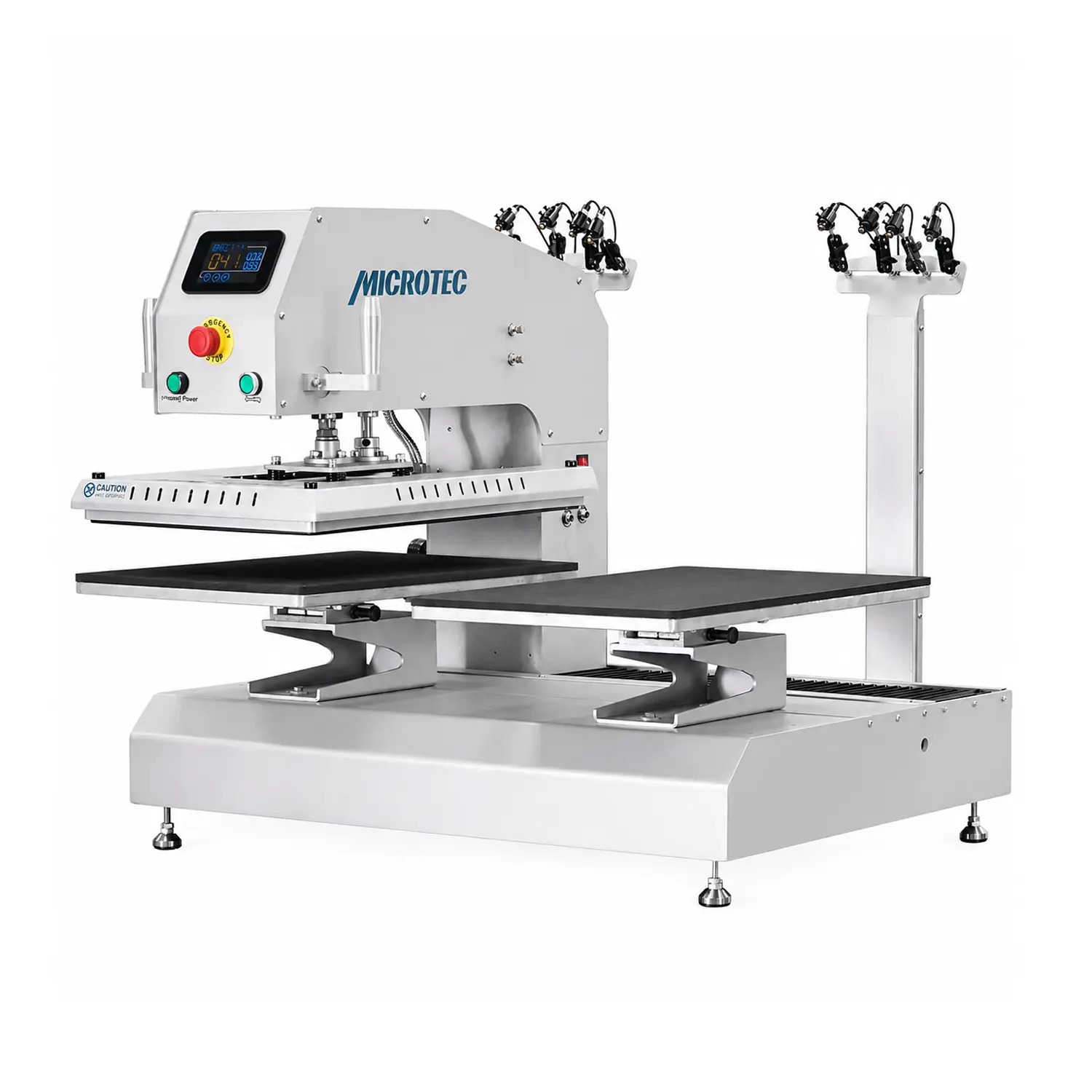
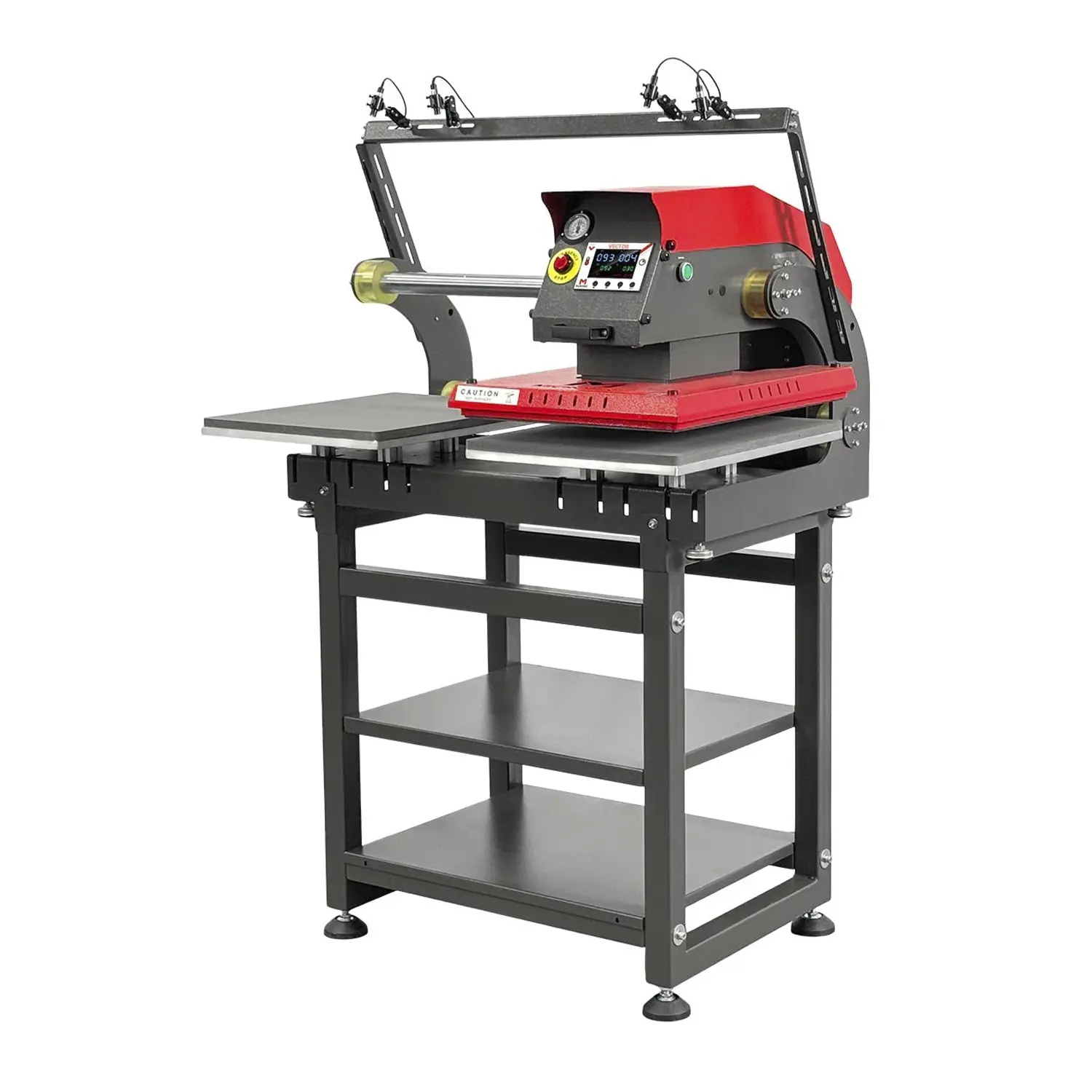
- MicroTec Vector 16×20 Dual Station Pneumatic with Laser Alignment: The lower-cost entry into pneumatic dual-station work. Integrated stand, automatic station switching, 8-point infrared laser alignment and a heating platen 21% thicker than the standard Vector Series for better heat retention and faster recovery between cycles. It draws 14.2 amps and needs a dedicated 20-amp circuit that is separate from whatever circuit your compressor requires. Coverage is a lifetime heating element warranty plus lifetime technical support.
- MicroTec Titan 16×20 Dual Station Pneumatic with Laser Alignment: The upgraded version of the same idea, with the thicker Titan heating platen, touchscreen control with real-time pressure display and programmable presets, automatic station switching and 8-point laser alignment. Rated up to 150 units per hour. Choose it over the Vector pneumatic when control depth and heat retention justify the step up, and choose the Vector when they do not.
Tier verdict: Hotronix Fusion IQ is the most flexible single machine and the only one here that avoids compressor ownership entirely. MicroTec Titan Pneumatic Slide-Out is the cheapest path to air-powered repeatability. Geo Knight DK20SP is the pick when you need pneumatic consistency and swing-away access in the same machine. The dual-station pneumatic models produce the most units per dollar, but only when both stations stay busy. No manufacturer throughput rating replaces a timed test with your own garments, transfers and operators.
Tier 5: Best Industrial Heat Presses Above $5,000
Above $5,000 these machines stop being substitutes for each other. Some maximize standard 16×20 throughput and force, others exist to press things a 16×20 physically cannot. Pick based on which jobs generate your revenue.
Heavy Industrial 16×20: Geo Knight 394-TS
The Geo Knight 394-TS 16×20 Twin Shuttle has the strongest published specifications for heavy industrial work at standard apparel size. Its stationary four-post frame, twin shuttle tables, aluminum worktables and air-powered system apply force well beyond what any manual press reaches, alongside 70 presets, interchangeable tables and a wide temperature range. For embossing, demanding pressure applications and continuous 16×20 production, that is measurable capability rather than marketing.
High-Volume and Oversized Alternatives
- Hotronix Dual Air Fusion IQ 16×20: Listed around $8,550 when checked, this pairs two 16×20 air-powered workstations with the Fusion IQ control platform. It suits a shop that values that operator interface and an apparel-first workflow over raw industrial force. Like the 394-TS, it needs an external compressor and a planned installation.
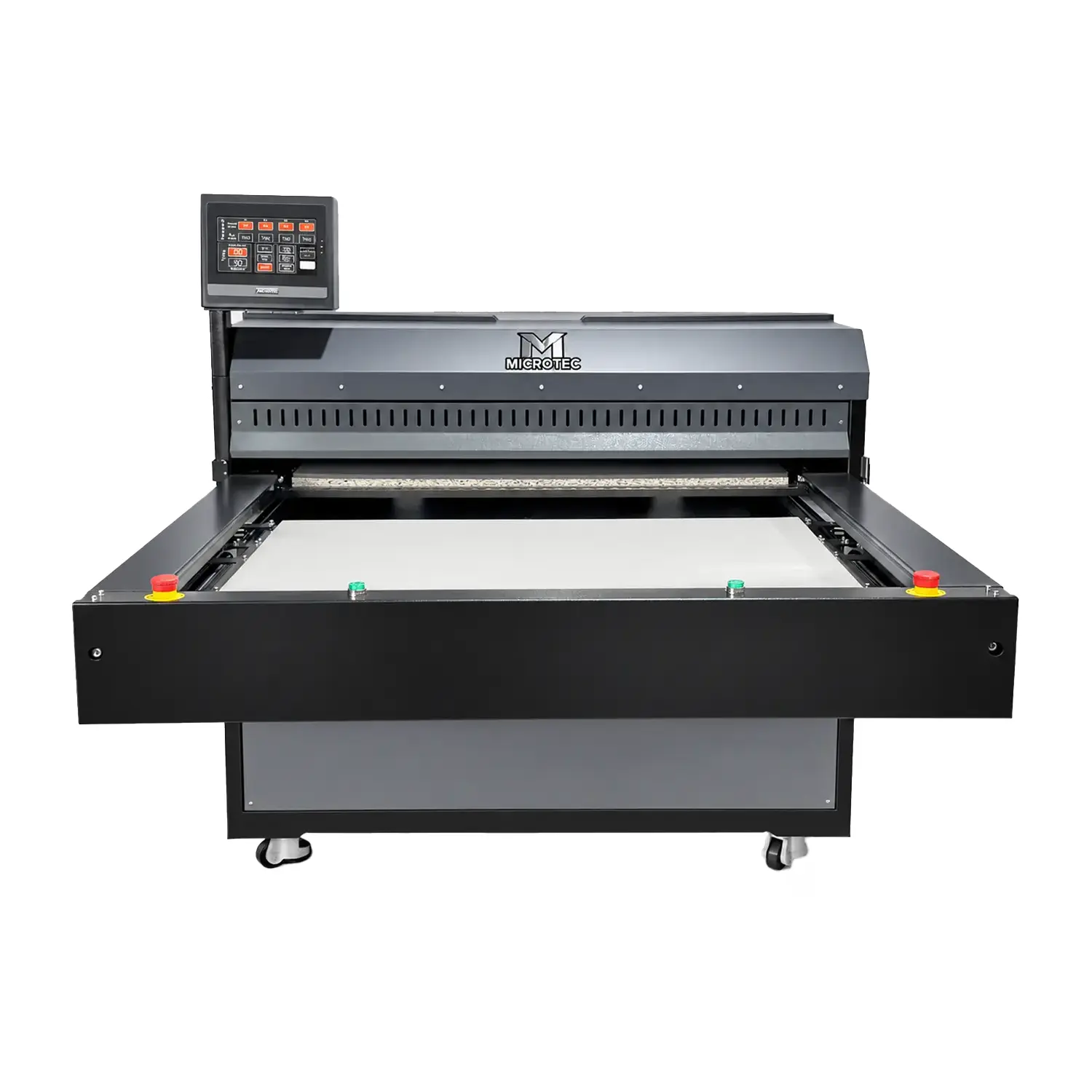
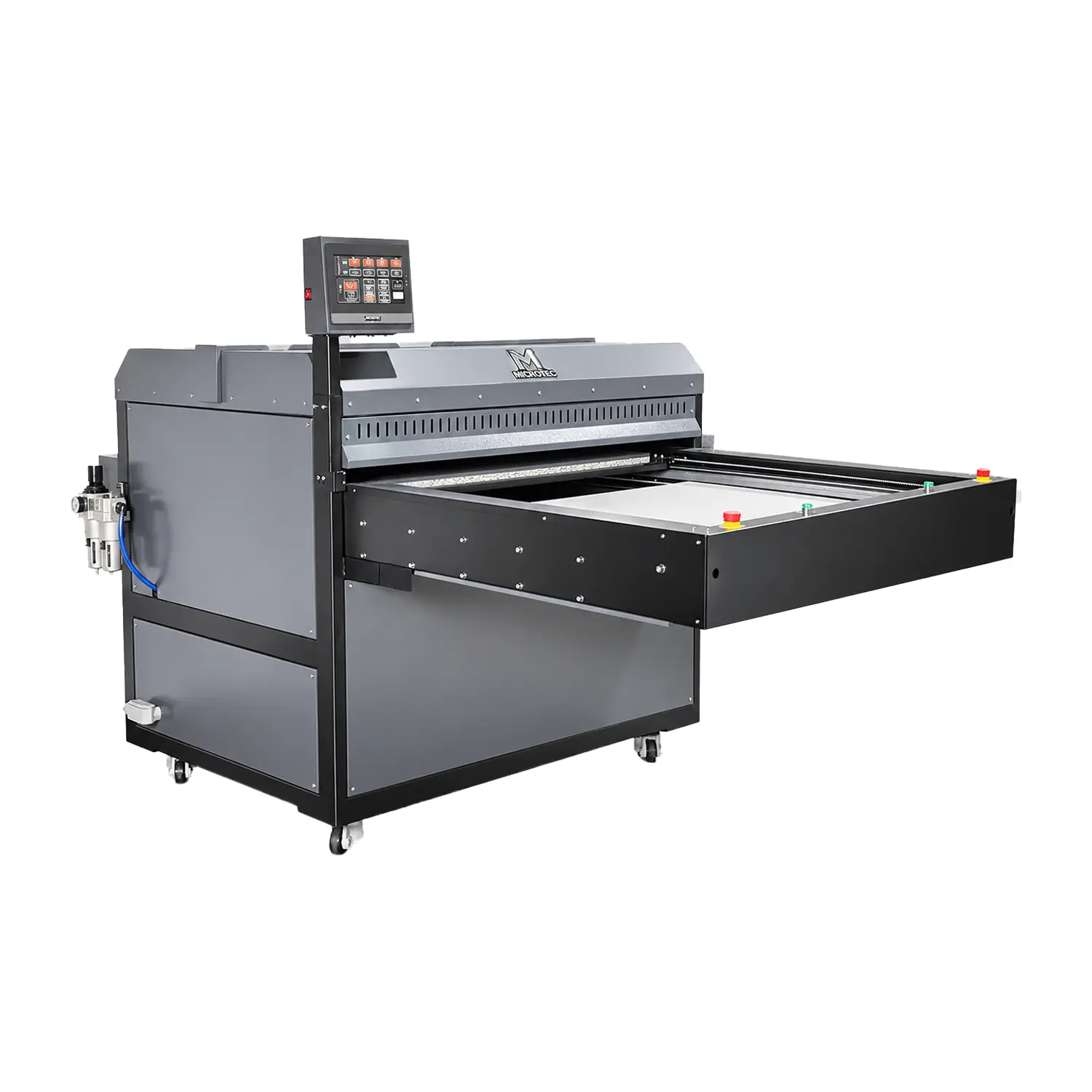
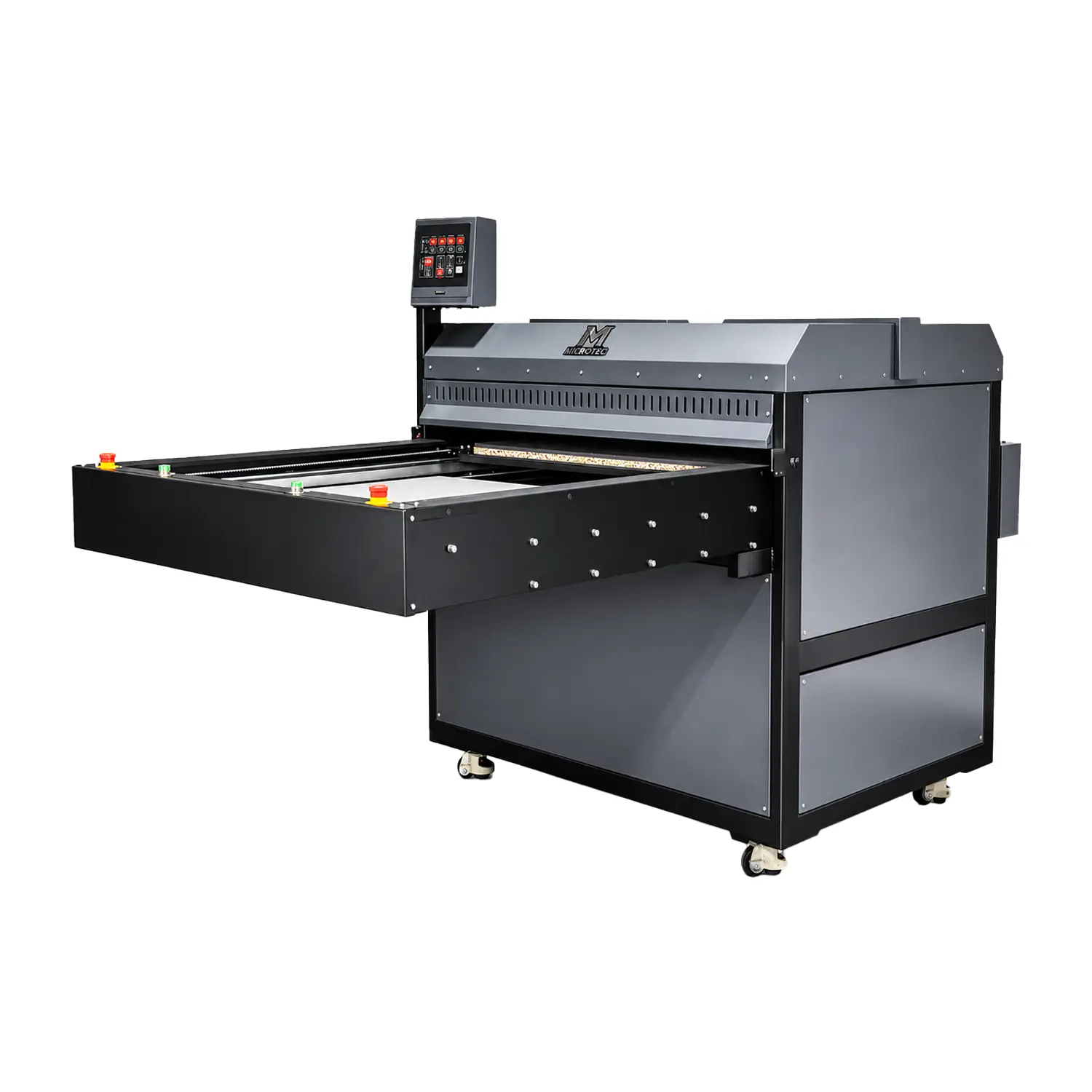
- MicroTec Atlas Ultra AT48-APS Large Format Double Station: This is not a better T-shirt press. It is a machine that makes products the others cannot. Its 39.4 x 47.2 in upper platen covers the full print area of an adult XXL all-over sublimation garment in a single cycle with no repositioning. Dual pneumatic cylinders and an automatic reciprocating shuttle tray system support up to 175 units per hour. It runs on 240V three-phase at 30 amps, requires 38 CFM of compressed air, weighs 1,961 lb net and ships by freight. Coverage is a 2-year machine warranty plus lifetime technical support. Compare it to the 16×20 machines only if oversized work is a real revenue line, not an aspiration.
Tier verdict: Geo Knight 394-TS for heavy 16×20 force and embossing. Hotronix Dual Air Fusion IQ for high-volume garment shops that want that control platform. MicroTec Atlas Ultra only when 40-inch-class capacity creates products a standard press cannot make. At this level, electrical service, compressor sizing, freight access, floor loading, warranty response time and a live production test all matter more than any online ranking.
Clamshell, Swing-Away, Dual Station or Pneumatic?
| Design | Best For | Main Tradeoff |
|---|---|---|
| Clamshell | Compact spaces, standard garments, straightforward production | The heater stays above the loading area and closes through an arc |
| Slide-out clamshell | Loading away from the heat without needing swing clearance | Still uses clamshell closing geometry |
| Swing-away | Open loading access, thick rigid substrates, true vertical pressure | Needs more side and rear clearance around the machine |
| Dual station | Throughput, by loading one platen while the other presses | Larger footprint and higher cost, wasted if volume is low |
| Pneumatic | Identical pressure on every cycle regardless of operator | Requires a compressor, air treatment, maintenance and its own circuit |
What DTF Shops Should Prioritize
DTF changes the priority order. Temperature ceiling stops mattering almost entirely, because DTF presses well below what any of these machines reach. What matters instead is even heat across the whole platen, pressure that lands the same on transfer number four hundred as it did on transfer number one, and enough platen area for the gang sheets you actually buy.
- Go 16×20, not 15×15. Oversized DTF gang sheets and adult full backs are the whole reason to run DTF, and a 15×15 forces repositioning that shows in the finished garment.
- Prioritize auto-open. DTF dwell times are short and over-pressing scorches the transfer. Auto-open removes the most common cause of ruined DTF prints.
- Watch pressure consistency before you watch anything else. Follow your film supplier’s medium-to-firm specification exactly. A pressure readout helps across shifts, and pneumatic removes the variance completely.
- Add the second station when your operator, not your press, is the bottleneck. DTF loading and peeling is hands-on, which is exactly the condition a dual-station press is designed for.
- Do not forget the peel. Cold-peel films need the garment to sit undisturbed, which is easier on a slide-out or swing-away platen than under a clamshell heater.
The Costs That Are Not the Press
The machine price is one line on the invoice. Depending on the model, budget for a sturdy table or stand, a dedicated 20-amp circuit or 220V and three-phase service, an air compressor with the right CFM rating plus hose and air treatment, freight and liftgate delivery, optional platens, silicone pads, protective sheets, alignment tools and spare supplies. Several of the machines above draw more than the 12-amp continuous load a standard 15-amp circuit safely supports, which makes the electrician a purchase requirement rather than an upgrade.
A press that cannot be installed safely, powered correctly or supported quickly is not a better investment than a less expensive machine that fits the shop you actually have. If a machine is the right one but the timing is wrong, ask about payment and financing options before stepping down a tier, because buying a press you outgrow in eight months is the more expensive mistake.
Which Heat Press Fits Your Shop?
- Cheapest way to test the idea: HTVRONT Auto Heat Press 2. Powered open and close, adjustable pressure levels and a slide-out drawer for around $298, aimed at home and light use rather than production.
- Best first commercial press: MicroTec Vector 15×15. Auto-open, slide-out loading, 3-year plate warranty and lifetime technical support in a machine a one-person shop can rely on.
- Best manual 16×20 on price: Hotronix MAXX 250. USA-made, lifetime heater coverage, optional lower platens, and we do not sell it.
- Best entry into a full 16×20: MicroTec Vector 16×20. Auto-open, slide-out, 3-year plate warranty, without paying for a platen system you may not use.
- Best 16×20 for a growing product line: MicroTec Vector Pro 16×20. Auto-open, slide-out and up to 12 quick-change lower platens so one press covers sleeves, labels, bags and youth garments.
- Best for full adult back prints and oversized gang sheets: MicroTec Vector 16×24, or the Vector Pro 16×24 if you also want the quick-change platen system.
- Best heavy-duty swing-away: Geo Knight DK20S. Welded steel, two-inch clearance, 70 presets, interchangeable tables and lifetime heating element coverage.
- Best swing-away without the weight: MicroTec Vector 16×20 Swing-Away. The same open geometry and vertical pressure with a secondary leverage handle and a lighter frame.
- Best all-round single station: MicroTec Titan 16×20 Hybrid. Auto-open or manual, slide-out, 12 optional platens and a lifetime heating plate warranty.
- Best throughput without a compressor: MicroTec Vector 16×20 Double Station. Two independent sliding platens rated up to 150 units per hour on standard power.
- Best advanced single station: Hotronix Fusion IQ. Swing or draw loading with touchscreen control and usage reporting.
- Cheapest route to pneumatic consistency: MicroTec Titan 16×20 Pneumatic Slide-Out.
- Best pneumatic swing-away: Geo Knight DK20SP. Air-powered pressure with true swing-away access for rigid goods.
- Best pneumatic dual station: MicroTec Titan 16×20 Dual Station Pneumatic, with the Vector pneumatic as the lower-cost version of the same workflow.
- Best oversized capacity: MicroTec Atlas Ultra AT48-APS. Only when all-over sublimation, panels or large textile graphics are a real revenue line.
If you are still deciding how the graphic itself gets produced, read our DTG vs DTF printing guide before choosing a press around one transfer workflow.
These recommendations compare published specifications, warranty terms and advertised prices rather than controlled long-term testing. The best T-shirt heat press is the least expensive machine that safely delivers the platen size, pressure, loading method, repeatability and throughput your real orders require. Before committing to a production press, run the same garment, transfer and dwell time on your shortlist if you can. Browse the full heat press collection or talk to a specialist before you decide.
Frequently Asked Questions
What is the best T-shirt heat press for a beginner?
A 15×15 auto-open clamshell with a slide-out lower platen is the practical beginner size. A low-cost automatic craft press can work for occasional orders, but a commercial press with a real warranty and parts path is the better choice the moment pressing shirts becomes income rather than a hobby.
Is a 15×15 or 16×20 heat press better for T-shirts?
A 15×15 platen covers most chest placements and standard shirts while using less space and power. A 16×20 gives real margin on adult full fronts, full backs and oversized transfers. Standard full-front designs run 12 to 14 inches wide, which a 15×15 technically covers but with almost no room for a misaligned transfer, so choose 16×20 if adult XL and larger garments are a normal part of your mix.
How much should I spend on a heat press for a T-shirt business?
A commercial starter machine generally falls under $750, a professional 16×20 lands between $750 and $1,250, and daily production usually justifies $1,250 to $2,500. Pneumatic and dual-station machines typically start above $2,500. The right budget depends on volume, platen size, utilities and how much a day of downtime costs you.
Is a clamshell or swing-away heat press better?
Clamshells save space and work well for standard garments. Swing-away presses rotate the heater completely clear of the loading area and press straight down, which suits thicker rigid substrates like wood, tile, crystal and plaques. Swing-away models need more clearance on the sides and behind the machine.
Is an auto-open heat press worth it?
Yes, if the operator handles more than one task. The platen releases the instant the timer ends, which removes the most common cause of over-pressed and scorched transfers. It does not automate loading, and pressure still needs manual adjustment unless the press is pneumatic.
What is a slide-out heat press and why does it matter?
A slide-out or draw-style press has a lower platen that pulls forward, away from the heated upper element, so the operator loads and aligns the garment in a heat-free workspace. It gives you most of the loading safety of a swing-away without needing the clearance a swing-away requires.
When is a dual-station heat press worth buying?
When your press is regularly waiting on your operator rather than the other way around. A second station lets one garment be dressed and aligned while the other is pressing. If your operator is usually waiting on the press, the second station adds cost and floor space without adding output.
Does a pneumatic heat press require an air compressor?
Yes. Pneumatic presses need an external compressor that meets the manufacturer’s CFM and pressure specification, and the compressor usually needs its own electrical circuit separate from the press. Budget for the compressor, air treatment, hose, noise, maintenance and floor space as part of the installed cost.
What is the best heat press for DTF transfers?
For DTF, prioritize even heat across the platen, repeatable medium-to-firm pressure as specified by your film supplier, auto-open to prevent over-pressing during short dwell times, and enough platen area for the gang sheet sizes you buy. A 16×20 is the practical starting point, and higher-volume shops benefit from dual stations or pneumatic pressure.
Can the same heat press handle sublimation, HTV and screen-print transfers?
Most flat heat presses handle DTF, HTV, sublimation and screen-print transfers as long as their temperature, time and pressure ranges meet the material supplier’s instructions. Sublimation additionally requires polyester fabric or polymer-coated substrates. Always follow the transfer and blank manufacturer’s settings rather than a generic chart.
Do I need a 16×24 heat press instead of a 16×20?
Only if full adult back designs or oversized DTF gang sheets are a regular part of your mix. A 16×20 covers most full fronts and many backs. A 16×24 platen measuring 15.7 by 23.6 inches presses a full adult back in a single pass with no repositioning and no seam, which is the difference between a clean finished garment and a visible overlap line. Power requirements are identical, only the platen and the footprint change.
Do heat presses need a dedicated electrical circuit?
Many 16×20 presses do. Machines drawing around 14 amps exceed the 12-amp continuous load a standard 15-amp circuit safely supports, which makes a dedicated 20-amp circuit the correct installation. Larger industrial presses may require 220V or three-phase service. Confirm the amp draw before delivery, not after.
What should I check before buying a commercial heat press?
Confirm platen size, heat consistency, pressure repeatability, loading ergonomics, electrical requirements, compressor needs, workspace clearance, optional platen availability, warranty terms, parts availability and technical support. For anything in the production tiers, ask for a demonstration using the transfers and garments your shop actually runs.
Need Help Choosing the Right Heat Press?
Talk to a Buffalo Imaging specialist about platen size, loading style, pressure system, electrical requirements, compressor sizing, freight and payment options. We will tell you when a smaller machine is the right call.
Buffalo Imaging
2015 Saybrook Ave.
Commerce, CA 90040
Local pickup available.